

From My Cold, Dead Hands
Wayne LaPierre's departure and the long arc of impact journalism.
Wayne LaPierre, the Executive Vice-President of the National Rifle Association, announced late Friday he was resigning. While he is reportedly leaving for health reasons, this comes just days before the start of a civil trial in New York, a case brought by the state’s Attorney General Letitia James, claiming the NRA committed tax fraud and LaPierre used millions of the non-profit’s dollars for personal use.
This is also the culmination of four years of investigative reporting from the Washington Post, Wall Street Journal, New York Times, New Yorker, The Trace, and many others that exposed the NRA’s out-of-control spending, self-dealing, and very public eating of their young, all under LaPierre’s watch. The NRA he leaves behind is a diminished version of the powerful membership organization that could once demand fealty from members of Congress of both parties.
But why did it take so long? Journalists have been investigating the NRA for decades. Jack Anderson’s book Inside the NRA: Armed and Dangerous--An Expose was published in 1996, just five years after LaPierre took the head job. You could fill a library with the exposés written about the organization since then. (When I looked on Amazon for books that took a critical look at the NRA, I stopped counting at forty.) Frontline has produced at least two documentaries about the group. Michael Moore’s Bowling for Columbine won an Academy Award. And back in 2000, I produced a documentary with Peter Jennings on ABC News about the NRA called The Gun Fight.
The premise of that documentary was that the NRA always needed a fight. For the organization to thrive, it always needed to be in battle with enemies, real or imagined. That motivated people to renew their membership each year and send in their checks. LaPierre, supported by a bevy of clever consultants, was skilled at throwing red meat to his members. Every election was the most important in our lifetime; every enemy must be vanquished, and every battle was a battle to the death. There was a boogeyman in every speech. Facts didn’t matter. The truth didn’t matter. All that mattered was scaring the members and getting them angry. Because LaPierre was an alchemist who knew how to turn fear and anger into money and power.
So, for the NRA base, every investigation into the NRA, every exposé, and every critical press mention confirmed the fear instilled in them: everyone was out to get them, and only the NRA would save them.
(I remember a conversation with LaPierre a few years after George W. Bush was elected. I asked him if having a pro-gun advocate in the White House made it difficult for him to raise money. He told me that wasn’t a problem because the UN was always coming out with anti-gun reports, and it was easy to rile up the membership with those.)
NRA members, passionate, check-writing voters, were always the underappreciated strength of the NRA. And while membership is down, it’s still more than 4 million strong. And perhaps more importantly, NRA’s playbook of stoking fear and anger was adopted by a crooked New York real estate developer and vast swaths of a political party to great success. The NRA is down. The pro-gun movement is alive and well.
LaPierre’s demise was ultimately self-inflicted. He was greedy and power-hungry. He pushed away those who built him up, people who were angry and knew where the bodies were buried. And angry insiders are like kindling wood for journalists, who turned it into a roaring fire.
The lesson: sometimes, impact takes time. A lot of time. In 1994, I was the junior partner to the very talented investigative reporter Walt Bogdanich on a story that exposed how tobacco companies intentionally made sure that every cigarette had the right amount of nicotine to sustain addiction. Recently, I was in a store that sold cigarettes and saw this sign.
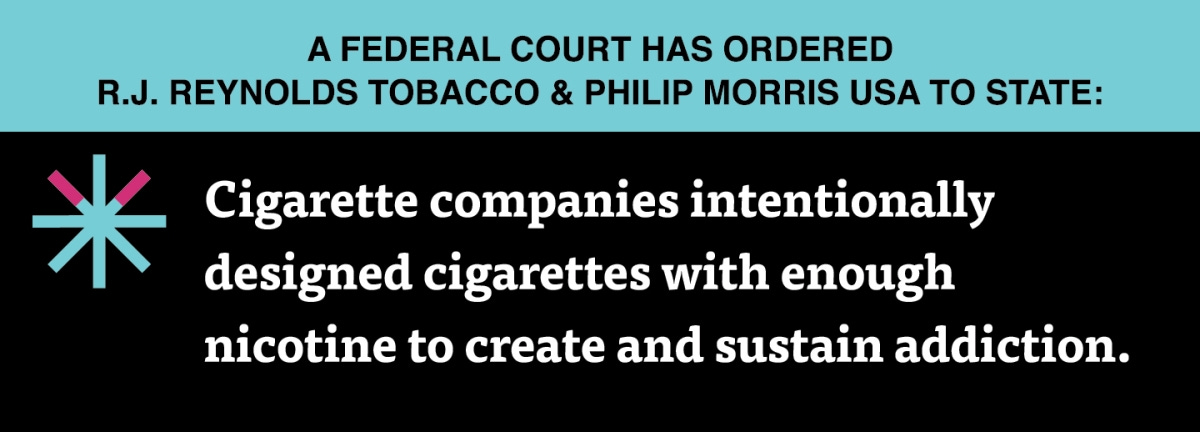
Twenty-nine years after our story, seventeen years after the tobacco companies lost a federal racketeering case and were required to make corrective statements, they were finally required to tell the truth publicly. Patience.
The List
Text
Gaming The Lottery - International collaboration
Wisconsin judge under investigation for jailing man over dispute with courthouse employee - Wisconsin Watch
Weed Gone Wild: 34 Cannabis Shops — But Just One Licensed — on the Lower East Side - The City and New York Magazine
Alleged Hamas financier holds stake in Cyprus company that mines Egyptian gold, leaked files reveal - ICIJ
Video
Inside the underground world of dog fighting: How the brutal blood sport thrives in the shadows - CNN
Go inside the ransomware negotiations with hackers - WPVI, Philadelphia
Inside the first fentanyl police unit in North Texas Part I: "It's a sad sight of humanity" - KTVT, Fort Worth
‘I can't die:' Florida mom ends up hospitalized following plastic surgery procedure - WTVJ, Miami
Dangerous light poles continue to plague city - WOIO, Cleveland
How shipping companies are using AI to prevent porch pirates WNCN, Raleigh
South Salt Lake police chief to retire after 2News investigation into lieutenant convicted of DUI - KUTV, Salt Lake
After fatal New Britain fire in illegal apartment, I-Team looks at city inspection records - WFSB, Hartford
Following 6 months without mail service, Valencia Grand residents get deliveries day after WPTV story airs - WPTV, West Palm Beach
Audio
There is little scrutiny of 'natural' deaths behind bars - NPR
Please consider supporting some of the excellent non-profit newsrooms featured in this week’s newsletter.